I can't write directly about the election, at least right now.
I've got no more insight than anybody else to say about how screwed up politics and humanity is.
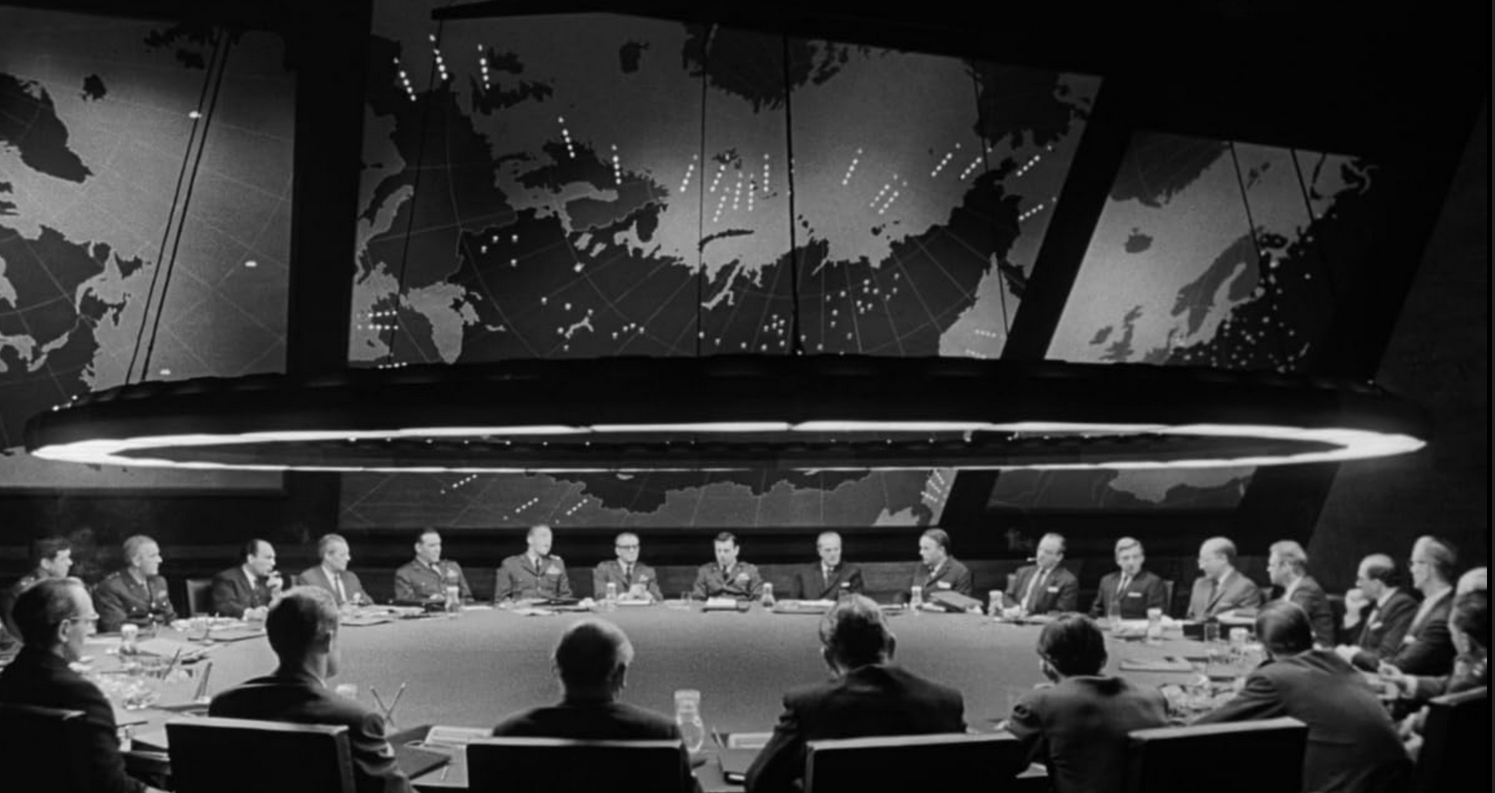
Instead, this is making me think about a timeless movie about how screwed up politics and humanity can be: Dr. Strangelove (Or How I Learned To Stop Worrying And Love The Bomb)
About The Movie
If you don't know it, Dr. Strangelove is the blackest of black comedies, made in 1964 by Stanley Kubrick.
Plot summary: When a paranoid U.S. general unilaterally orders a nuclear strike on the Soviet Union, the President and his advisers scramble to prevent global catastrophe.
It's in black and white.
Was co-written by counter-culture genius Terry Southern (who co-write Easy Rider).
It's Kubrick's funniest film and stars Peter Sellers in three roles.
Does that sound like it's an alltime great or comedy from that description?
Put that aside.
It is.
Pre-1968 movies feel like they're always presentational, silly and don't hold up.
This holds up eerily, especially in an absurd election month.
My History With The Movie
Growing up, I loved watching movies with my dad.
We'd discover new stuff but he loved turning me on to old movies.
We literally would circle upcoming showings in TV Guide the day it arrived in the mail.
"On The Waterfront" got a circle, as did "The Poseidon Adventure".
But Dr. Strangelove would get triple circled.
I remember one time getting ice cream at Swenson's as a kid of about 10 years old with my dad and there was some jackass in there with a suit being an absolute nightmare asshole customer to the teenager working the counter.
I expressed confusion at the adult being so simultaneously stupid and rude and I'll never forget what my dad told me.
He said, "I want to let you in on a little secret: Most adults don't know anything."
To extrapolate that a little further, in life I've learned that it's not only most adults but also most experts don't even know what they're doing.
This movie is a perfect illustration and why it feels so relevant this month.
If You Haven't Seen It
Maybe just go watch this when you have the time.
The rest of this post is going to refer to plot points and characters;
I'm not worried about spoilers for a 60-year-old movie but this post won't have any value if you haven't seen it.
More importantly, it's one of the greatest movies of all time.
Believe me, it's not homework.
It's like the recent Don't Look Up but more universally loved.
Now, on with the movie.
What Things In The Movie Seem To Mean
Stanley Kubrick movies can be tough to decipher.
I can watch 2001: A Space Odyssey maybe another 50 times and I still won't have a clue about that nutball ending with the star fetus in space.
Interpreting Kubrick just like interpreting David Lynch doesn't give definitive answers, instead they lead to interesting personal meanings.
I'm going to toss out some observations of mine from the movie.
General Ripper - played by Sterling Hayden.
The war-mongering general and his insanity are the driver of the whole situation.
It's hard not to recognize Trump-ish mental cognitive and paranoid problems in how he acts and obsesses about precious bodily fluids and fluoride.
How The 'Sane' Characters React To The Nutty Characters - Peter Sellers plays 3 characters and the most famous one is the not-so-former Nazi doctor, Dr. Strangelove.
But his other portrayals are less showy and saner characters, British officer Mandrake and U.S. President Muffley.
Mandrake has to overcome Gen. Ripper's insanity and President Mandrake in the War Room has to make the best of advice from Strangelove and Gen. Turgidson (George C. Scott).
They are both trying to do the right thing and play by the rules in dealing with political lunatics and are completely ineffectual.
Sound familiar?
The Political Spectrum From The Middle To Extreme Right - The major characters represent politics from the middle to crazy levels of war-mongerers.
Mandrake is a relatively normal guy trying to do the right thing constrained by bureaucrazy.
The President is the definition of a rational centrist and can't control his own War Room or the Russians.
General Kong follows orders with a patriotic zeal.
Turgidson prioritizes military action over caution.
Dr. Strangelove is a mad scientist representing the technocratic/military-industrial complex detached from morality.
And furthest right is General Ripper who is a paranoid, far-right military hawk.
Lately it sure seems like the axis of political perspective have shiften nutty right.
Or just shifted nutty.
Richard Nixon or Ronald Reagan would be cast as RINO (Republicans In Name Only) pussies if they were part of the current political scene.
In the movie, there's not a real voice from the center or rationalism.
Five Stages Of Death - This might be a stretch but Gen. Ripper's reaction thing kinda represents Elizabeth Kubler-Ross’ famous five stages of death: Denial - Obsessed with "fluoride in the water" refusing to accept reality outside his paranoid worldview.
Anger - Lashing out at perceived enemies, channeling rage into action.
Bargaining - Rationalizes his actions with convoluted ideology.
Depression - Shows moments of isolation and fatalism, recognizing the destructive consequences of his own paranoia.
Acceptance - Fully commits to his mission, resigned to the catastrophic outcomes he's triggered, embracing his self-imposed "duty" to fight perceived evil.
Banality Of Evil - The end of the world is just as likely to come from stupid happenstance circumstances instead of an evil intent.
The most planning in the War Room is about the sex fantasy of "Plan R" repopulation bunkers.
Stopping the plan hinges on having change for a payphone and dealing with the phone company.
Ok, that's all I got for you.
Good night and good luck.